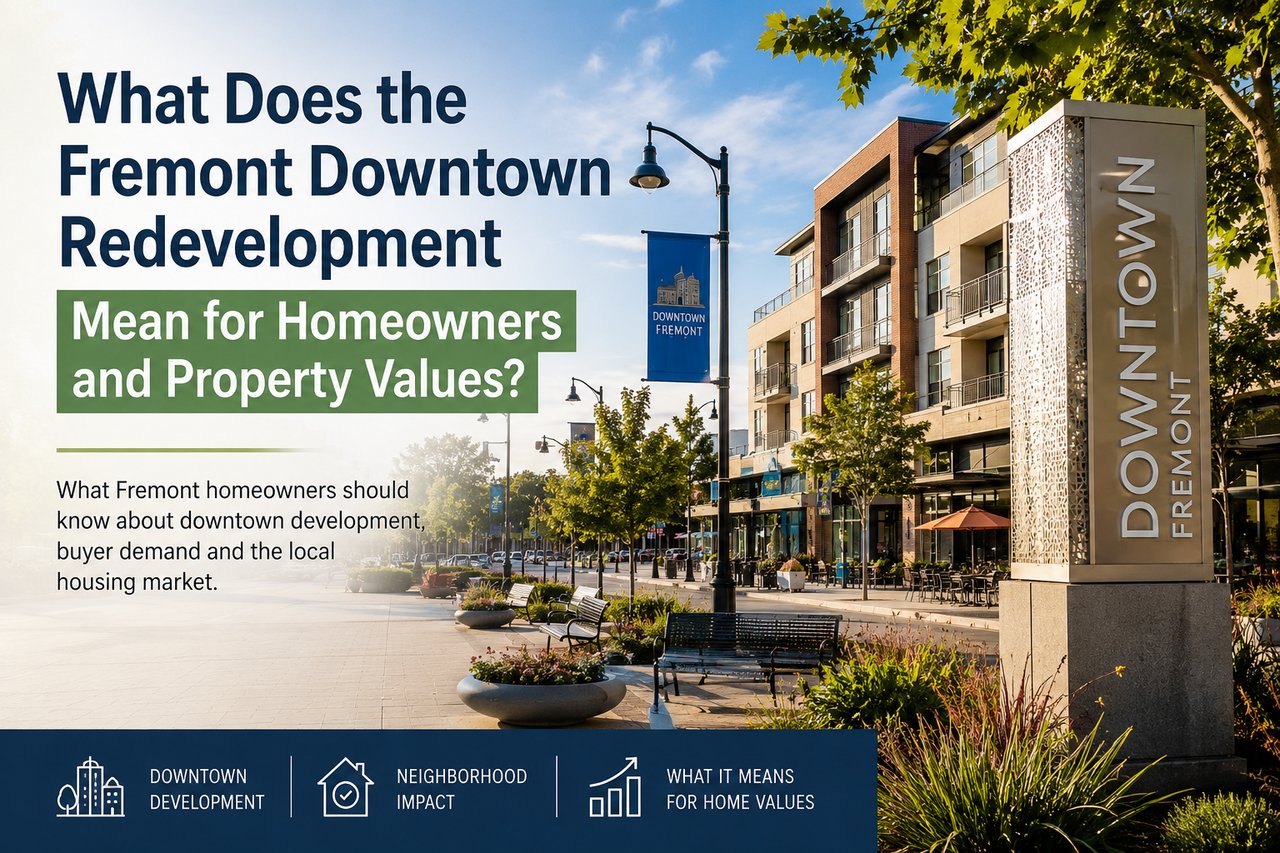
Fremont has been working toward creating a true downtown for years, and that vision is continuing to take shape.
New housing, retail, public spaces and transit-oriented development are changing the city's urban core. For homeowners, the bigger question is what those changes could mean for Fremont's neighborhoods and the local housing market over time.
Downtown redevelopment doesn't guarantee higher home values. Real estate values are influenced by interest rates, inventory, employment, the broader economy, schools, location, home condition and many other factors.
But continued investment in a city can influence how buyers perceive it. Better amenities, improved walkability, new businesses and a more active downtown can all become part of the reason buyers choose one city over another.
Here's what Fremont homeowners should know about what's happening downtown and what it could mean for the housing market.
What's Actually Happening Downtown
Fremont has been working toward a true downtown for years, and the pieces are coming together.
The city's Downtown Fremont planning initiative centers around the Capitol Avenue corridor and the area near the Fremont BART station, with a mix of housing, retail, public spaces and pedestrian-friendly streets.
This isn't simply a future concept.
Fremont has already invested significantly in Capitol Avenue and the surrounding downtown district, while additional residential and mixed-use development continues to reshape the area.
The Fremont BART station also remains an important part of the downtown story, giving residents direct transit access throughout the Bay Area.
California continues to encourage cities to add housing near jobs and public transportation, which means transit-oriented development is likely to remain an important part of Fremont's long-term planning.
The Transit-Oriented Development Factor
Access to transportation has always been an important part of Fremont's appeal.
Fremont's central location provides convenient access to Silicon Valley, the Peninsula and the greater East Bay, with BART, I-880, I-680 and the Dumbarton Bridge providing multiple ways to get around the region.
Creating more housing, restaurants, retail and public spaces around an existing BART station adds another dimension to that accessibility.
For some buyers, being able to live near transit while also having restaurants, coffee shops, parks and everyday services nearby can make an area more desirable.
That doesn't mean every home near downtown will appreciate because of redevelopment. But when buyers compare Fremont with other parts of the Bay Area, a more established downtown can become another reason to consider the city.
Which Fremont Neighborhoods Could Feel the Impact Most?
The effect of downtown redevelopment won't be identical across Fremont.
Homes closest to the downtown core may experience the changes more directly, while neighborhoods farther away could benefit more indirectly from an improvement in Fremont's overall amenities and perception.
Central Fremont and Centerville
These areas have some of the most direct connections to the evolving downtown.
As Capitol Avenue and the surrounding district continue to develop, residents of Central Fremont and nearby Centerville could see additional restaurants, services and public spaces become increasingly accessible.
For buyers who value convenience and proximity to BART, that can become an important part of the location.
Glenmoor
Glenmoor remains one of Fremont's most established neighborhoods and offers something very different from the higher-density housing being developed downtown.
Its larger lots, tree-lined streets and predominantly single-family housing give buyers a more traditional neighborhood environment while still being relatively close to Central Fremont.
As downtown amenities improve, buyers considering Glenmoor may increasingly view proximity to the city center as another benefit of the neighborhood.
Sundale, Parkmont and Brookvale
Sundale, Parkmont and Brookvale also offer convenient access to Central Fremont while maintaining a residential feel.
For buyers comparing Fremont with San Jose, the Peninsula or other East Bay communities, the combination of established neighborhoods, transportation options and improving city amenities can help strengthen Fremont's overall appeal.
Niles
Niles is somewhat different.
It has its own historic commercial district, architecture and neighborhood identity, so its appeal isn't dependent on downtown Fremont.
However, continued investment elsewhere in the city can still contribute to the broader perception of Fremont as a place with multiple distinct neighborhoods, commercial districts and amenities.
That's one of Fremont's strengths. Downtown doesn't need to replace the identity of areas like Niles. It can add another layer to what the city offers.
The Walkability and Lifestyle Factor
One of the most interesting parts of Fremont's downtown redevelopment is the emphasis on walkability.
Historically, Fremont has been much more suburban than cities such as San Francisco, Oakland or Berkeley. Many daily activities require driving, even within the city.
Downtown development is gradually changing that experience in the city center.
More restaurants, retail, housing and public spaces within walking distance of one another can make Central Fremont feel more connected.
For buyers, particularly those coming from denser parts of the Bay Area, that can be appealing.
Walkability isn't going to determine the value of every Fremont home, but it can influence how buyers think about a location and the lifestyle that comes with it.
If you're curious how buyer priorities are changing locally, our post on what Fremont home buyers want in 2026 looks more closely at what we're seeing in today's market.
What Does This Mean If You're Thinking About Selling?
If you're considering selling a home near downtown Fremont, redevelopment becomes one part of the overall positioning of the property.
The key is putting it in the proper context.
If your home offers convenient access to BART, restaurants, shopping, parks or the downtown district, those can be valuable selling points.
At the same time, buyers are smart. We'd rather explain what's happening, what has actually been approved and why the location may appeal to certain buyers.
From there, pricing, preparation, presentation and marketing still have to do the heavy lifting.
Redevelopment may influence buyer perception, but it doesn't replace the fundamentals of selling a home well.
What Does This Mean If You're Buying in Fremont?
For buyers, downtown redevelopment is another factor to consider when comparing Fremont neighborhoods.
Some buyers want to be close to BART, restaurants and a more active city center.
Others would rather have a quieter residential setting, larger lot or more separation from commercial areas.
Neither preference is necessarily better.
The important thing is understanding how the neighborhood fits your lifestyle today while also knowing what is planned nearby.
If you're buying close to downtown, reviewing proposed development and current construction can be just as important as reviewing the home itself.
The Bottom Line
Fremont's downtown transformation is one of the more important long-term stories to watch in the local real estate market.
For homeowners, the real question isn't whether redevelopment is simply "good" or "bad" for property values.
It's how new housing, businesses, transportation, public spaces and continued investment affect buyer demand and the way people perceive Fremont as a place to live.
Ultimately, the impact on an individual property will depend on factors like location, neighborhood, home condition, current inventory and what buyers are willing to pay at that particular moment.
That's where local market data matters.
Curious what the changes in Downtown Fremont could mean for your specific home? Schedule a conversation with the Belliveau Realty Group and we'll take a look at your neighborhood, recent comparable sales and can share what's happening nearby.