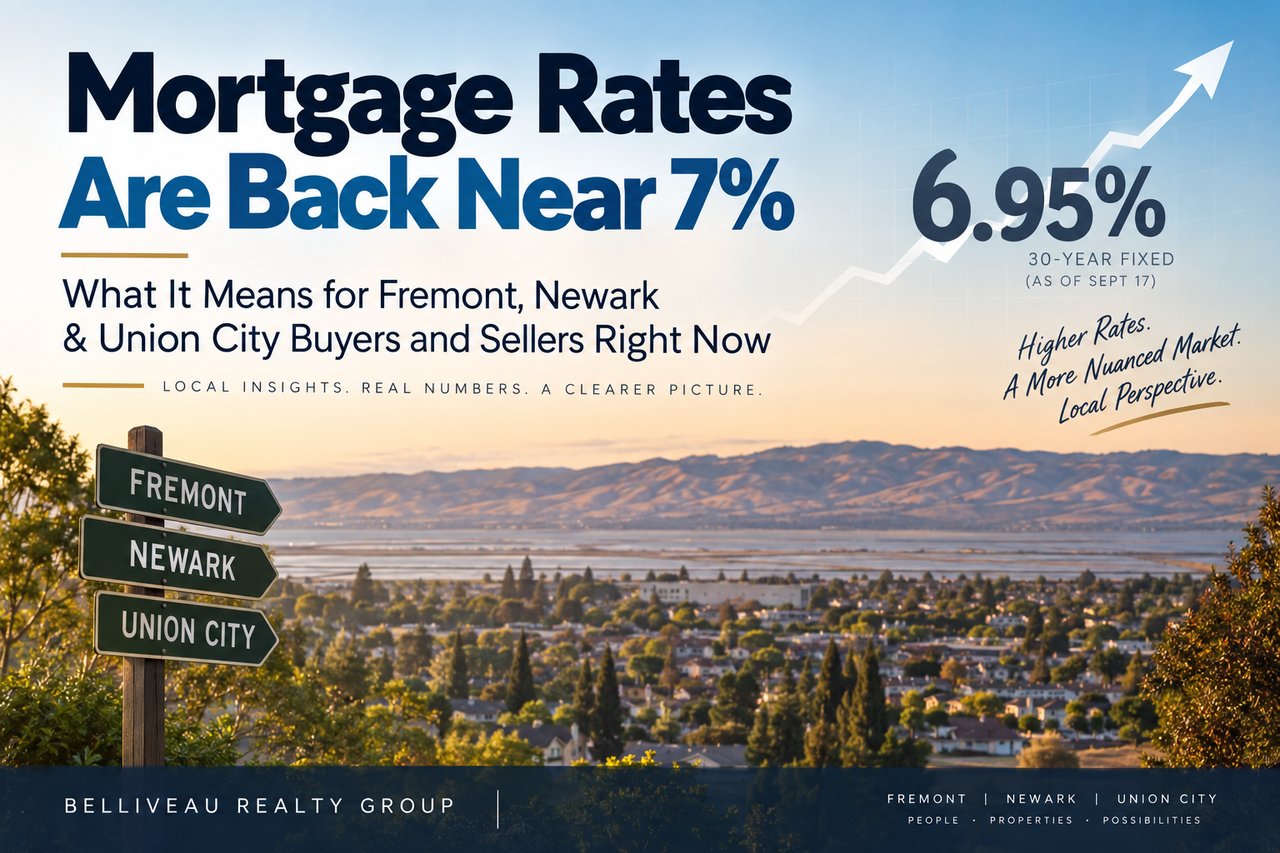
For much of 2026, buyers were waiting for mortgage rates to come down.
For a while, it looked like that was happening. Rates moved lower earlier in the year and spent much of the summer in the mid-6% range. But over the past few weeks, that trend has changed quickly.
As of September 17, the average 30-year fixed mortgage rate had climbed to 6.95%, according to Freddie Mac, up from 6.76% just one week earlier.
That puts rates right back near 7%.
For buyers who have been sitting on the sidelines waiting for lower borrowing costs, that is an important shift. But just as important is what we are seeing locally.
Fremont, Newark and Union City are not reacting to the changing rate environment in exactly the same way.
Why Mortgage Rates Moved Higher
There are a lot of factors that influence mortgage rates, but inflation and the bond market have been two of the biggest drivers recently.
At the Federal Reserve's annual gathering in late August, the Fed Chair emphasized that inflation remained above the Fed's 2% target and that price stability needed to remain a priority.
Then, on September 16, the Federal Reserve raised its benchmark interest rate by 0.25 percentage points, bringing the federal funds target range to 3.75% to 4%.
Mortgage rates do not move directly with the federal funds rate, but they are heavily influenced by expectations around inflation, economic growth and longer-term Treasury yields.
The result is that the downward rate trend many buyers were hoping would continue into the fall has reversed, at least for now.
What We’re Seeing in Fremont, Newark & Union City
Higher rates typically put pressure on affordability and can cause buyers to become more selective.
But as we have discussed in our recent East Bay Market Updates, the Tri-City market is rarely one-size-fits-all.
Here is what we have seen so far in September:
The difference between the three cities is important.
Fremont homes are still moving relatively quickly, averaging just 16 days on market so far this month. Well-prepared homes in desirable neighborhoods that are priced correctly can still attract strong buyer interest even with higher mortgage rates.
Newark is moving at a slower pace, with homes averaging 28 days on market. That does not mean there is no demand. It means buyers generally have more time to evaluate their options and sellers need to be especially thoughtful about pricing.
Union City sits somewhere in between, averaging 18 days on market so far in September.
We saw similar differences in our August 2026 East Bay Market Update. Fremont averaged 21 days on market in August, compared with 30 days in Newark and roughly 28 days in Union City.
The takeaway is simple: there isn't one "Bay Area housing market." Even within Fremont, Newark and Union City, buyer demand, affordability and competition can look very different.
What Higher Rates Mean for Buyers
The most immediate impact is purchasing power.
For example, on a $1.5 million 30-year mortgage, the difference between a 5.5% rate and a 6.95% rate is roughly $1,130 per month in principal and interest alone. The difference between a 4.5% rate and a 6.95% rate is roughly $1,863 per month.
That can add up quickly and may change the price range a buyer is comfortable targeting.
But higher rates do not automatically mean buyers should stop looking.
As we covered in our guide to what $1.5 million buys in Fremont, Newark and Union City, buyers have different options depending on where they focus.
Fremont generally commands the highest prices of the three cities, while Newark and Union City can offer more house/yard for the money.
We also recently looked specifically at Newark versus Fremont, where our 2026 year-to-date data showed Newark's average single-family home sale price running roughly 22% below Fremont's.
That price difference becomes even more meaningful when borrowing costs rise.
For buyers who are flexible on location, expanding the search from Fremont into Newark or Union City can potentially offset some of the purchasing power lost to higher mortgage rates.
Buyers May Also Have More Room to Negotiate
Another important piece of the equation is leverage.
When homes take longer to sell, buyers may have more opportunities to negotiate. That is especially worth watching in Newark, where homes are currently taking longer to sell on average than in Fremont.
Fremont can be a different story.
At 16 days on market so far in September, desirable homes that are priced correctly can still move quickly. Buyers waiting for rates to fall before making an offer could find themselves competing for the same home later if rates eventually improve and more buyers return to the market.
The right strategy depends on the property, the neighborhood and how much competition there actually is.
What Higher Rates Mean for Sellers
For sellers, higher mortgage rates do not eliminate demand, but they make pricing and preparation even more important.
As we have discussed throughout 2026 in our posts like how long it takes to sell a home in Fremont, today's buyers are paying close attention to value. With higher monthly payments, buyers tend to be more selective about the homes they pursue and what they are willing to pay.
A home that is prepared properly, presented well and priced accurately can still generate strong interest. But there is less room to test the market with an aggressive price and hope buyers eventually catch up.
That is why we continue to look at each city, neighborhood and property individually. What works for a well-positioned home in Fremont may not be the right strategy for a property in Newark or Union City, especially as market conditions continue to shift.
Don't Try to Time the Mortgage Market
One of the biggest questions buyers ask us is whether they should buy now or wait for rates to come down.
The reality is that nobody knows exactly where mortgage rates will be three or six months from now.
Earlier this year, the expectation was that rates would continue moving lower. Instead, inflation concerns, higher Treasury yields and changing Federal Reserve policy have pushed borrowing costs back toward 7%.
Rates could move lower again. They could also remain elevated or move higher.
For buyers, the better question is whether the numbers work for your situation today.
For sellers, the question is whether your home can be positioned effectively in the market that exists today rather than the one we had last year.
The Bottom Line
Mortgage rates approaching 7% certainly make affordability more challenging, but they do not tell the entire story of the local housing market.
Fremont homes are still moving relatively quickly. Newark buyers may have more negotiating room. Union City continues to provide another option for buyers looking throughout the Tri-City area.
That is why looking at the local numbers matters.
If you're thinking about buying, selling or simply trying to understand how the recent change in mortgage rates affects your plans, reach out to the Belliveau Realty Group.
We can walk through the numbers, look at what is actually happening in Fremont, Newark or Union City and help you determine what makes sense for your specific situation.